B.Sc. in Peace and Human Rights Studies
Program Profile
The Peace and Human Rights Studies (PHRS) Department was established within the College of Humanities in the academic year 2016-2017 Its first and main academic programme is the Bachelor of Arts in Peace and Human Rights.
The Peace and Human Rights Studies programme is designed and regularly reviewed to meet the current and future needs of the Kurdistan Region and Iraq for qualified professionals in conflict resolution, peacebuilding, transitional justice, and human rights advocacy.
The curriculum adheres to international human rights standards and provides a balanced foundation across both the theoretical principles of peace studies and the practical application of human rights frameworks. Seminar and training-based sessions further strengthen students’ critical analysis abilities, intercultural dialogue, and hands-on mediation skill
Occupational profiles of graduates
Graduates of this programme are equipped with a solid foundation in conflict analysis, international human rights law, and trauma-informed peacebuilding methodologies. Their expertise in critical thinking, negotiation, and intercultural communication prepares them for diverse careers essential to the stability and development of the Kurdistan Region and Iraq.
Typical roles for graduates include:
1. Peacebuilding and Conflict Transformation Specialist::
- Designing and implementing long-term reconciliation and social cohesion programs aimed at fostering trust among diverse community, religious, and political groups across the region.
- Developing and managing initiatives focused on dialogue and non-violent communication training for civil society and local government leaders.
2. Human Rights and Governance Consultant:
- Advising local and regional institutions (e.g., Ministries, Parliament) on aligning policies and legislation with international human rights standards and good governance practices.
- Working within human rights institutions (commissions, ombudsman offices) on strategic planning, awareness campaigns, and policy development.
3. Lecturer/teacher at Secondary and High Schools:
- Human Rights: Principles of equality, non-discrimination, and civic responsibility.
- Genocide Studies: The history of genocide (e.g., the Anfal Campaign, the Yazidi Genocide) to foster recognition, empathy, and prevention mechanisms.
- Social Skills: Training youth in mediation, intercultural literacy, and active citizenship.
Qualification awarded
Bachelor of Arts in Peace and Human Rights
Length of programme
4 Years
Number of credits
240 ECTS credits
Mode of Study
Full time on campus
Read more about the programme
Get detailed information about the programme requirements, courses, credits, and educational objectives as a PDF file.
Program Educational Objectives (PEOs)
The Department seeks:
1. To prepare graduates for impactful careers in governmental, non-governmental, and international organizations by providing them with the necessary knowledge and practical skills for peace and human rights work.
2. To serve as a regional hub for peace and human rights education by cultivating a new generation of leaders who can address the unique challenges of the Kurdish and Iraqi contexts.
3. To foster a culture of academic inquiry and public service, encouraging graduates to continue their professional development and contribute to building a more just and peaceful society.
Program Learning Outcomes
After successfully completing this programme, students should be able:
1. To critically analyze national and international policies related to human rights and peacebuilding and develop evidence-based strategies to advocate for policy reform.
2. To apply principles of multiculturalism and intergroup dialogue to bridge cultural divides and promote peaceful coexistence in diverse communities.
3. To design and execute a comprehensive research project, from formulating a research question to presenting and defending their findings, in a manner that addresses a realworld peace or human rights issue.
4. To communicate complex ideas effectively in both English and Kurdish, and will be able to design and lead training sessions on topics such as conflict resolution and human rights education.
5. To identify and navigate ethical dilemmas in their professional work, demonstrating a commitment to integrity, accountability, and the well-being of vulnerable populations.
6. To apply theories and practical skills of crisis management and mediation to de-escalate conflicts and facilitate productive dialogues in high-stakes situations.
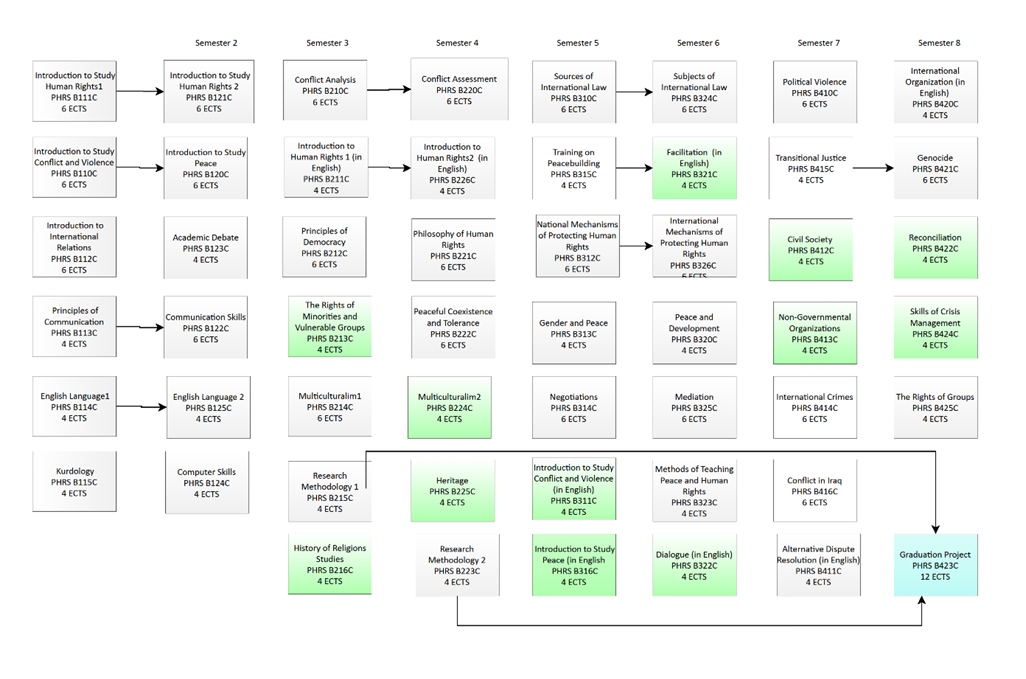
Programme structure diagram with credits
Yearly Timeline
Sept. 1, 2026
⚠️ First year students start around mid-October
⚠️ First year students start exams around 20 of January
July 1, 2027
Check out the full academic calendar on UoD's webstie.
Programme Coordinator

Assistant Professor in Department of Human Rights and Peace
Peace and Human Rights Studies
College of Humanities
University of Duhok
Apply to the Programme
Public undergraduate admissions in the KRG region are managed centrally by the Ministry of Higher Education through the online ZankoLine portal (regayzanko.com). After Grade 12 Baccalaureate results are released, high schools provide students with unique login credentials to rank their preferred universities and B.Sc. majors during a 10–14 day registration window. Final placement is automatically determined by the student's Grade 12 average, subject choices, and department capacity.